Butler’s Garter Snake
Thamnophis butleri (Cope, 1889)
| French Name | Couleuvre à petite tête |
|---|---|
| Max. Recorded Length | 73.7 cm / 29 inches |
| Range | Indiana, Michigan, Ohio, Ontario, Wisconsin |
| Pet Trade Availability | ★★☆☆ sometimes available |
| Captivity Rating | ★★★☆ good |
| Search for This Species |


Note: These species pages are in various stages of completion. Some are basically finished; others are very much under construction. Please be patient while I work on this section.
The Butler’s Garter Snake is a relatively small garter snake species found in the Great Lakes region. Like its close relative, the Short-headed Garter Snake, and unlike other garter snakes found in its range, it has a small, blunt head. In Canada, it is found in southwestern Ontario, mostly along the Detroit River, St. Clair River and Lake Saint Clair, along with a relict population in Luther Marsh. It is also found in the Lower Peninsula of Michigan, northwestern Ohio, northeastern Indiana, and southeastern Wisconsin.
This snake feeds preferentially on soft-bodied invertebrates. Studies have shown that earthworms take up 80 percent or more its snake’s diet. Small amphibians or leeches have also been recorded. Even so, Butler’s garters will eat fish and even mice in captivity.
Conservation
In Canada, the Butler’s Garter Snake is listed as a threatened species under the federal Species at Risk Act. It is protected under Ontario’s Endangered Species Act and Fish and Wildlife Conservation Act, 1997, and may not be kept in captivity or collected from the wild in that province without a permit.
It’s on Indiana’s state endangered species list; it’s also listed as a threatened species in Wisconsin, where efforts to protect Butler’s garter habitat have clashed with planned development on more than one occasion.
It is not listed as threatened or endangered in Ohio; however, all native reptiles and amphibians require a permit to be kept in that state.
Captive Care
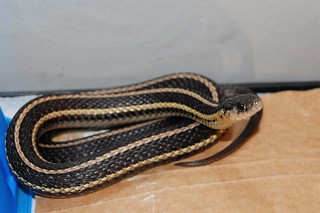 In my experience, this is not a difficult species to care for, despite Sweeney’s (1992) assertion that “in captivity the snake can prove to be a choosy feeder, often accepting only earthworms to begin with and sometimes even refusing those.” While Butler’s garters are shy and sometimes nervous, they usually take earthworms voraciously — so much so that if you have more than one Butler’s garter in a cage, it’s wise to separate them for feeding to prevent them from trying to swallow the same worm from opposite ends.
Feeding babies can be difficult due to the baby snakes’ extremely small size and the difficulty of procuring small enough earthworms. Chopped nightcrawler pieces do work, though you may have to offer them on tweezers.
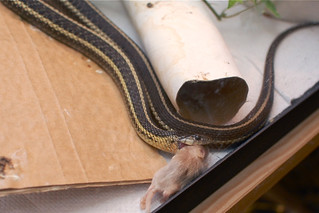 Butler’s garters can be converted to a mouse-based diet; see the article I co-authored with Jeff Hathaway about it. Fish will also be taken, though Halloy and Burghardt (1990) report that Butler’s garters are a relatively awkward feeder on live fish.
Butler’s garters are small enough that they don’t need to be kept in anything much larger than a 10-gallon cage.
A female Butler’s garter in my care died in March 2011 at the age of approximately 10 years, 8 months. I believe the record is something like 14 years.
If you have experience with this species and would like to share, please contact me.
For general information on keeping garter snakes in captivity, please see the Care Guide.
Articles and News
- Wisconsin De-Lists Butler’s Garter Snake
- Butler’s Garter Snake to Lose Protected Status in Wisconsin
- Sarnia Asked to Take in Butler’s Garters
- Wisconsin DNR Reduces Areas for Butler’s Garter
- Developer, Snakes Swap Land for Subdivisions, Habitat
- Butler’s Garter Won’t Be De-Listed in Wisconsin
- Butler’s Garter Controversy Goes National
- Legislature Threatens to De-List Butler’s Garter
- Butler’s Garters an Obstacle to Hospital Construction
- Environmental Triage for Butler’s Garters in Wisconsin
- Highway Project Includes Ecopassages for Butler’s Garters
- Sewerage District, Construction Firm Face Charges for Disturbing Butler’s Garter Habitat
- Domestic Mice as Food for Butler’s Garter Snakes, Thamnophis butleri
Sources
Catling, P. M. and B. Freedman. 1980. “Food and feeding behavior of sympatric snakes at Amherstburg, Ontario.” Canadian Field-Naturalist 94: 28-33.
Ernst, Carl H. and Evelyn M. Ernst. 2003. Snakes of the United States and Canada. Washington: Smithsonian Books.
Halloy, M. and G. M. Burghardt. 1990. “Ontogeny of fish capture and ingestion in four species of garter snakes (Thamnophis).” Behaviour 112: 299-318.
Harding, James H. 1997. Amphibians and Reptiles of the Great Lakes Region. Ann Arbor: University of Michigan Press.
Rossi, John V. and Roxanne Rossi. 2003. Snakes of the United States and Canada: Natural History and Care in Captivity. Malabar FL: Krieger.
Rossman, Douglas A., Neil B. Ford and Richard A. Seigel. 1996. The Garter Snakes: Evolution and Ecology. Norman OK: University of Oklahoma Press.
Sweeney, Roger. 1992. The Garter Snakes: Natural History and Care in Captivity. London: Blandford.
Tennant, Alan and R. D. Bartlett. 1999. Snakes of North America: Eastern and Central Regions. Houston: Gulf.